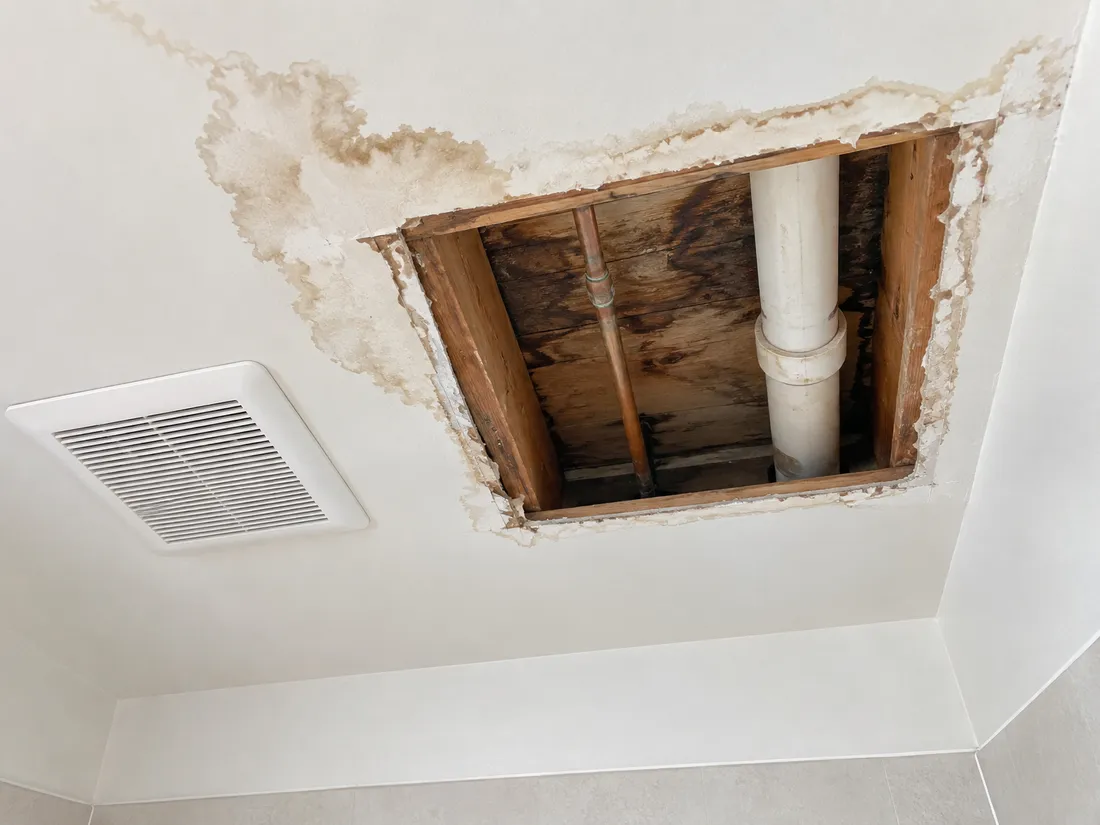
Who pays for water damage in a condo?
Two facts decide it: the source of the leak, and the part of the building it soaked. California’s condominium law, the Davis-Stirling Common Interest Development Act, splits a building into pieces and gives each piece a default owner of the repair bill. Then it lets your community’s declaration, the CC&Rs, change that split. The statute says one thing, and your documents may say another.
This guide sets out the default. It is not legal advice, and it cannot read your CC&Rs for you. What it can do is tell you which questions to put to your association, your insurer and, if it comes to that, a lawyer, and how to keep the damage from growing while they answer.
What the Davis-Stirling Act says by default
The rule sits in Civil Code §4775. Each part opens with the same words, “unless otherwise provided in the declaration”, so your community’s own documents can override any of it:
- Common area: “The association is responsible for repairing, replacing, and maintaining the common area.”
- Your unit: “The owner of each separate interest is responsible for repairing, replacing, and maintaining that separate interest.”
- Exclusive use common area: the owner is “responsible for maintaining” it, while “the association is responsible for repairing and replacing” it.
Common area is everything in the development except the separately owned units (§4095). Where exactly your unit ends is set by §4185(b): when walls, floors or ceilings are the boundaries, “the interior surfaces of the perimeter walls, floors, ceilings, windows, doors, and outlets located within the separate interest are part of the separate interest and any other portions of the walls, floors, or ceilings are part of the common area.”
In plain terms, the paint and the drywall face on your side are yours. By default, the framing and the space inside a wall or a floor between two homes belong to everyone. A condominium plan can draw that line somewhere else, which is why the plan is worth finding.
Is the homeowners association (HOA) responsible for water damage in California?
For common area, by default, yes: the association repairs it. Water that starts in a roof, a main line or a shared drain stack is, under the default rule, water coming out of common area, and the damaged framing or ceiling cavity it reaches is often common area too.
Your own unit is a different matter. The flooring, the cabinets, the fixtures and the finished surfaces inside the boundary are yours to repair under §4775 unless your CC&Rs shift them to the association. That is true even when the leak began somewhere you do not control. Who repairs a thing and who ends up paying for it can differ, because insurance and your governing documents sit on top of the statute.
Balconies, patios, windows and exterior doors catch a lot of owners out, because by default they are exclusive use common area. Civil Code §4145 lists “shutters, awnings, window boxes, doorsteps, stoops, porches, balconies, patios, exterior doors, doorframes” and windows that serve a single unit. You maintain them; the association repairs and replaces them.
Moving out costs you, too. Under §4775(c), “the costs of temporary relocation” during repairs the association is responsible for “shall be borne by the owner of the separate interest affected.”
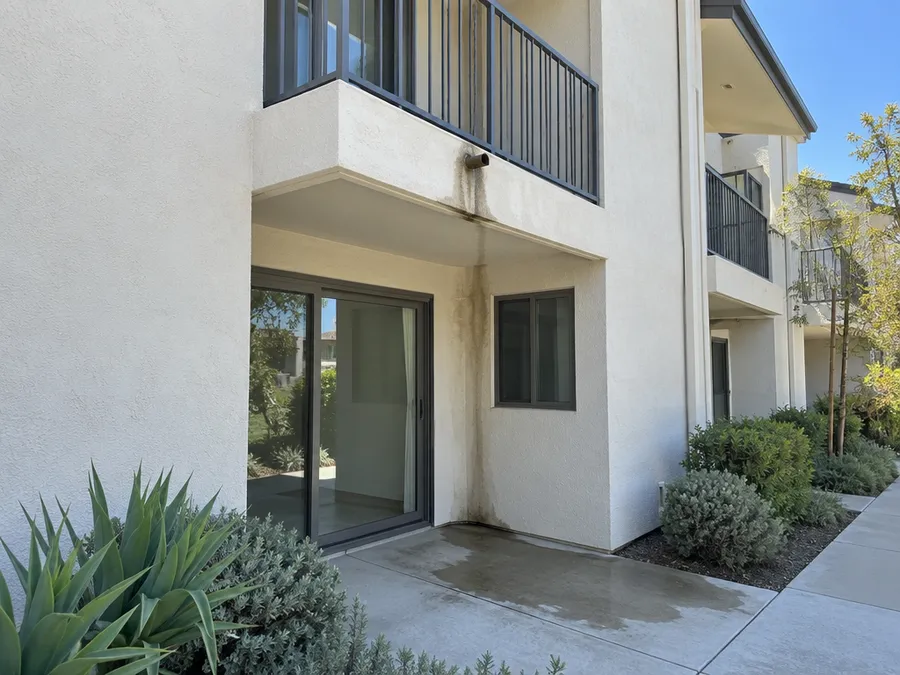
One more, for older leaks. In a condominium, Civil Code §4780 makes the association responsible, unless the declaration says otherwise, for repairing common area damaged by “wood-destroying pests or organisms”. Whether rot from a slow leak falls under that wording is a question for the association or a lawyer. Rot is also where mold remediation usually enters the picture.
When the water comes from the unit above
The statute tells you whose repair each piece is. It does not stop the water. When the ceiling starts dripping, the order is practical, and none of it depends on who pays:
- Turn off the power to any wet ceiling light and move belongings out of the drip.
- Tell the upstairs owner and the association at once, in writing as well as in person. A text or email with the time on it is a record. If the upstairs unit is empty, the manager may be able to reach the owner.
- Photograph everything before it is moved or cut: the ceiling, the walls, the floor, and the stain line as it spreads.
- Tell your own insurer. Your policy and the association’s may each respond to a different part of the damage.
- Get it dried. A water damage restoration company measures moisture in the ceiling, walls and floor, opens only what it has to, and keeps drying until the readings reach a target set at the start.
If the water is dirty, from a toilet or a shared drain line, treat it as sewage. That changes what can be saved; the sewage cleanup page explains why.
Two insurance policies, and the warning your association has to send you
Two insurance policies usually sit over a condo. The California Department of Insurance’s residential guide describes them. “The condominium association generally purchases insurance for the building structure and common areas, such as corridors and walls.” A unit-owners policy, the Department says, covers personal property, loss of use and liability, and “also includes coverage for damages to the interior of the unit and improvements for which the unit owner is responsible to maintain in accordance with the governing rules of the condominium association.”
The Department also names loss assessment coverage, which pays toward “certain assessments that the condominium association makes as a result of a loss.” That matters when a big repair lands on every owner as a special assessment.
Your association already told you some of this. Every year its budget report must include a summary of its insurance, and Civil Code §5300(b)(9) requires the summary to carry a statement in boldface. Part of it reads: “the association’s policies of insurance may not cover your property, including personal property or real property improvements to or around your dwelling.” It adds: “Even if a loss is covered, you may nevertheless be responsible for paying all or a portion of any deductible that applies.” Find last year’s budget report. It names the insurer, the policy limits and the deductible, and you are entitled to review the full policies on request.
This page cannot tell you what either policy covers for your loss. The insurer answers that.
A condo leak map: where it started, and the default rule
Most condo leaks start in one of a handful of places, and the default rule treats each one differently. The table uses the statute’s defaults only. Your CC&Rs or condominium plan can change any row.
| Where the water started | What it usually wets | Default rule | Source |
|---|---|---|---|
| Your own sink, toilet, dishwasher or water heater | your floor, cabinets and drywall, and maybe the unit below | the owner repairs the unit; the association repairs common area it reaches | Civil Code §4775(a) |
| The unit above | your ceiling, walls and floors | the same split: interior surfaces are yours, the cavity between the homes is common area | §4185(b), §4775 |
| The roof, a main line or a shared drain stack | ceiling cavities, shared walls, then finishes | common area, repaired by the association; interior surfaces stay with the owner | §4095, §4775(a) |
| A balcony, patio door or window | the wall below it, the floor inside the door | exclusive use common area: the owner maintains, the association repairs and replaces | §4145(b), §4775(a)(4) |
| Rot found behind a long, slow leak | framing and subfloor | in a condominium, the association repairs common area damaged by wood-destroying organisms | §4780(a) |
Keep the restoration company’s paperwork whichever row you are in. Its moisture map shows how far the water travelled and which materials were wet, its photos show the damage before anything was removed, and its scope says what came out and why. The company does not decide who pays. What its records do is give the association, the neighbour and both insurers the same facts to work from, which is usually faster than each side arguing from memory.
Where these rules meet Chula Vista
The Census Bureau’s American Community Survey for 2024, as republished by Census Reporter, counts 91,470 housing units in the city and puts roughly a third of them in buildings of two or more units, closer to half once attached single-family homes are included; the survey’s margins on the smaller categories are wide, so read those shares as rough. The survey counts buildings, not ownership, so it cannot say how many of those homes are condos rather than rented apartments.
In Eastlake and Rolling Hills Ranch, a charge on your property tax bill can add to the confusion. The City runs open space maintenance districts in both, and its Eastlake district was “formed in 1986 to pay for costs for maintenance of open space lots.” Rolling Hills Ranch’s district covers “landscaping and storm water improvements”. Those districts belong to the City, not to your association, and they do not repair anything inside your building. If runoff from a landscaped City slope is involved, the district is a separate conversation from your HOA.
When a disagreement needs a lawyer
Most leaks get settled between the owner, the association and the insurers. When they do not, the statute has a step before court. Civil Code §5930 says an association or a member “may not file an enforcement action in the superior court unless the parties have endeavored to submit their dispute to alternative dispute resolution.” That requirement is narrower than it sounds: it covers actions for declaratory, injunctive or writ relief, alone or with a limited money claim, and not assessment disputes.
Whether your case fits, and what your CC&Rs actually say about water damage, are questions for a California lawyer who handles community association law. The Department of Real Estate’s guide to living in a common interest development is a good plain-English starting point on the CC&Rs, which it calls “the ground rules for the operation of the association.” It advises buyers to “thoroughly review the CC&Rs and any other governing documents” before they purchase, and it is just as useful after a leak.
What does not have to wait for any of that is the drying. If your unit is wet now, the cost of water damage restoration climbs every day the water sits, whoever ends up holding the bill.